

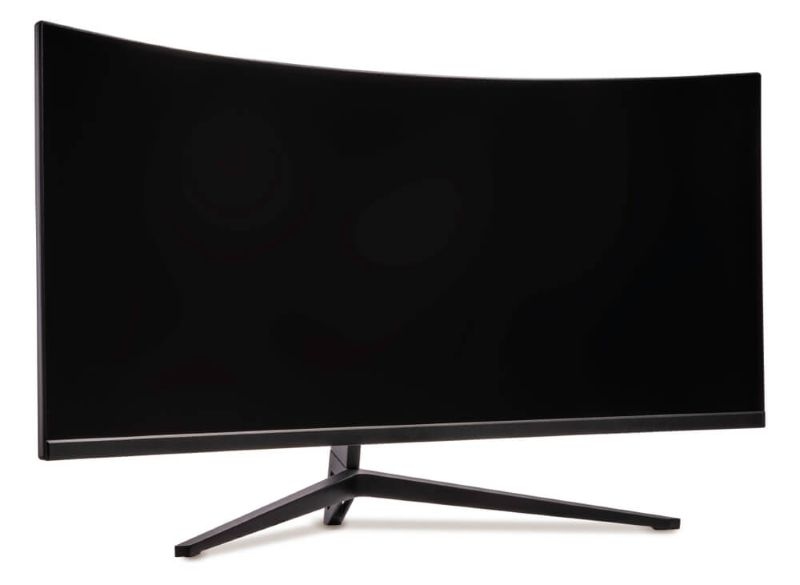
Curved monitors used to feel like a gimmick. A few years ago most gamers stuck with regular flat screens. Now things look different. Scroll through gaming setups online and you will see curved displays everywhere, especially the wider ones.
So naturally people start wondering if a curved gaming monitor is actually better for gaming or if it is just another trend that looks good on a desk.
The truth is simple. A curved screen does change how games feel, but whether it is better depends on what you play and what kind of setup you want.
A curved gaming monitor is a screen that bends slightly toward the viewer instead of staying completely flat. The curve is subtle, not something dramatic like a movie theater screen.
Manufacturers usually describe the curve with numbers like 1000R or 1500R. Lower numbers mean a deeper curve.
The reason behind this design is fairly straightforward. Human vision is not flat. Our eyes naturally see the world in a curved field of view. When a monitor follows that shape, the edges of the screen stay closer to your eyes.
Because of this, many players say a curved screen feels more like an immersive gaming display than a regular flat monitor.
You will see this design most often on larger screens and especially on an ultrawide curved monitor.
Discover More: Crafting Your Dream Gaming Station with Top Gaming Equipment
A curved gaming monitor can make certain games feel larger. The curve pulls the sides of the display slightly toward you, which makes the screen fill more of your vision.
You notice this more in games where the environment stretches across the screen.
Examples include:
In a racing game you can see more of the road around you. In open world games the landscape spreads wider across the display.
This is why curved screens are often described as an immersive gaming display. The experience feels a bit closer to sitting inside the game instead of looking at a rectangle on a desk.
The curved vs flat gaming monitor discussion usually comes down to personal preference.
Flat screens have been the standard for decades, so many players are used to them. Curved displays simply change how the screen sits in your field of view.
A curved gaming monitor can feel better on larger screens because the edges stay closer to you.
Some advantages include:
On the other hand, flat monitors still work well in many setups.
Some players prefer them because:
That is why the curved vs flat gaming monitor debate still comes up whenever someone buys a new display.
The ultrawide curved monitor is where curved screens really started making sense.
Ultrawide displays use a 21:9 aspect ratio, which is much wider than the normal 16:9 monitor. That extra width allows you to see more of the game world without zooming out.
Without a curve, a very wide screen can feel awkward because the edges sit far away from your eyes.
Adding a curve helps keep the whole display within your viewing range.
An ultrawide curved monitor works especially well in games like:
Many players also use an ultrawide curved monitor instead of running two separate monitors.
Also check: Must-Have Gaming Accessories For Every Type Of Gamer
The curve of the screen affects how the display feels, but the real performance of a monitor depends on its gaming monitor features.
A curved display with weak specs will still perform worse than a flat monitor with strong hardware.
Some important gaming monitor features include refresh rate, response time, panel type, and resolution.
Refresh rate controls how often the screen updates every second. Many gaming monitors now run at 144Hz or higher, which helps make motion look smoother.
Response time measures how quickly pixels change color. Lower numbers help reduce motion blur during fast gameplay.
Panel technology also affects the image. IPS panels usually provide accurate colors, while VA panels offer deeper contrast. VA panels appear often in curved displays.
Resolution determines image sharpness. Popular choices include 1080p, 1440p, and 4K. Many ultrawide curved monitor models use 3440 × 1440 resolution, which balances clarity and performance.
These gaming monitor features usually matter more than the curve itself.
Competitive players often stick with flat monitors, especially in fast shooter games.
Flat displays keep the image perfectly straight, which some players prefer when aiming.
Still, a curved gaming monitor can work perfectly well for competitive gaming if it has strong gaming monitor features like high refresh rates and low response times.
For most players the difference during actual gameplay is fairly small.
Explore More: RGB Lighting Setup Guide: Transform Your Gaming Experience
A curved gaming monitor changes how the screen feels during gameplay. On larger displays and especially on an ultrawide curved monitor, the curved design can make games feel wider and more engaging.
That is why many people describe it as an immersive gaming display.
Flat monitors are still common and remain popular for competitive gaming setups.
When comparing a curved vs flat gaming monitor, the better option usually depends on the type of games you play and how large your screen is.
Here are quick answers to common questions about curved gaming displays.
A curved gaming monitor can make games feel more immersive because the screen wraps slightly around your field of view.
The curved vs flat gaming monitor choice depends on preference. Curved displays focus on immersion, while flat monitors are often used in competitive gaming.
An ultrawide curved monitor provides a wider view of the game world and works well for racing games, simulations, and large open world titles.
This content was created by AI